
Why do we care about culture?
WHY IT WORKS: Culture audit edition
Sometimes what really makes the difference isn’t what is shown or talked about openly, you have to shine the light into the corners
Does culture eat strategy for breakfast?
There is a well known (and apparently misattributed) phrase in corporate consulting that ‘culture eats strategy for breakfast’ used to imply that no matter how robust your business strategy is, the culture of your organisation will always be the factor that helps or hinders your success. While the origins of the phrase may be questionable, the evidence suggests that there is fire under this smoke. But what is culture? Culture is embodied in the unspoken rules of ‘how we do things around here’ which can be seen in the encoded beliefs, values, practices and symbols (1) that you might find on the website, standard operating procedures, handbooks all the way down to the recycling signs and office decor. These small and big things are indicators of what the organisation says is important to them, what is prioritised when making decisions and how they want to show up.
Sometimes what is said and what is done may be in conflict. For instance you join an organisation that says we are all one team, transparency is key and there is a town hall meeting that everyone attends weekly so we all know exactly what is going on. The first meeting rolls around and you find that the CEO doesn’t attend, there is no update from any teams but there are snacks and office games. Which is the true representation? Likely a combination of what you are experiencing first hand, these are the underlying assumptions and unspoken rules in play, and those formal stated values and symbols shared with you (2). Even if there isn’t a formal set of stated values, those assumptions and unspoken rules exist.
Research shows that misalignment between your new decision or strategy and your culture can make the transition harder and slower (3) because you’re swimming against the tide of how things have always been done. This is both in terms of how the structures and processes are set up as well as what people believe is meant to be done. Conceptually this is completely understandable - having worked in one way towards the service of one thing, it can be bewildering to be told that everything you knew has now shifted. It destabilises expectations, power and knowledge dynamics, which creates discomfort and in turn resistance.
So how not to be eaten?
Overcoming this kind of organisational inertia is possible, but needs to be incorporated into the implementation plan. And for that, you first need to be aware of what your culture is and where those challenges might be. The goal is not to establish whether you have a good culture or a bad culture (if there is such a thing) but where culture may be aligned or misaligned with what you want to achieve and the people you might like to work with.
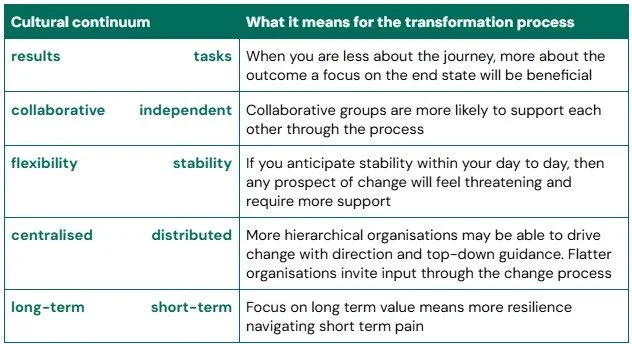
This ‘desktop audit’ is a way to use your own observations to understand whether your culture is going to support the plans you have (transformation, growth, refocusing) for your organisation. It is not an exhaustive list of cultural aspects, but five key areas most pertinent to transformation and observable through this methodology (4)(5). Change will be easier when your culture aligns well with your intended end state. Each dimension will also have an impact on how you approach implementation.
When should I use a full culture assessment?
Traditional methods of measuring culture are often surveys and focus groups, which can take some time and resources, but also allow a way to tap into those ‘underlying assumptions’. Organisation size or time/resource availability means those tools are not always fit for purpose. This audit is a practical way to gain insight, which you can supplement with other methods as necessary.
If you are:
10-20 people strong, consider a couple of informal conversations to add colour to the audit
20-50 people, then 5 more structured interviews (a simple set of questions)
50-100 people, focus groups or culture survey tools
100+ people, culture survey tools with some focus groups or interviews
The accuracy of these methods is dependent on whether people feel comfortable being honest about their experience, even when they are told their data will be anonymised such as in larger surveys.
Read more
Schwartz S. H. (2014). Rethinking the concept and measurement of societal culture in light of empirical findings. J. Cross Cult Psychol. 45 5–13. 10.1177/0022022113490830
Schein, E. H. (1985). Organizational culture and leadership: A dynamic view. Jossey-Bass.
Janicijevic, Nebojsa. (2012). Organizational culture and strategy. Ekonomika preduzeca. 60. 127-139. 10.5937/ekopre1204127J.
Angula, N., Louw, P., Schroeder, A., Vaino, E. & Tripodi, L. (2025). Impact of Corporate Culture on Strategic Management: A Systematic Literature Review. International Journal of Management Science and Business Administration, 11(1), 7-15.
Tadesse Bogale, A., & Debela, K. L. (2024). Organizational culture: a systematic review. Cogent Business & Management, 11(1). https://doi.org/10.1080/23311975.2024.2340129